Message Areas - "Kicking Cars?"
Train-Sim.Com Message Areas
"Kicking Cars?"
Email this topic to a friend
Printer-friendly version of this topic
Bookmark this topic (Registered users only)
Previous Topic | Next Topic Conferences MSTS Activity Design (Protected) Original message
Notch8 (3 posts)
Jun-28-01, 01:48 AM (EST) "Kicking Cars?" Has anyone figured out how to "bleed off the brakes" on the cars so they can be "kicked". This would also allow for "flying switches" or "drops". I've messed around a bit and you have to be going about 60 mph to get cars to "coast" any sizeable distance. MSTS seems to simulate cars going into "emergency" when they are cut off. Being able to "kick" and "drop" cars would open up a wide range of very challenging activities. As a real shortline railroader, I would find "kicking" and "droping" cars as a fun activity that I'm not allowed to do with real trains for safety reasons. Drew Hosick's runaway activity was a blast, but his 20 or so cars are rolling down a steep grade and not quite what I'm looking for. All I would like to do is "kick" cars on level track. I'll offer the designer of what I deem the best "kick" and "drop" activity a cab ride if they're in my area. Cheers. Alert Edit | Reply | Reply With Quote | Top
Table of Contents
Subject Author Message Date ID RE: Kicking Cars? SP9800 Jun-28-01 1 RE: Kicking Cars? KingJPW Jun-28-01 2 RE: Kicking Cars? Gixxer86g Jun-28-01 3 To Kick Cars..... funnelfan Jun-28-01 4 RE: To Kick Cars..... AcesHigh Jun-28-01 5 Air Brake System Is Not Like A Truc... sd90mac Jun-29-01 6 RE: Air Brake System Is Not Like A ... Gixxer86g Jun-29-01 7 RE: Air Brake System Is Not Like A ... AcesHigh Jun-29-01 8 RE: Air Brake System Is Not Like A ... JimStrenk Jul-02-01 9 Doesn't Exist On A Dash 9 or GP38 sd90mac Jul-02-01 10 RE: Air Brake System Is Not Like A ... wza24 Jul-03-01 11 RE: Air Brake System Is Not Like A ... sd90mac Jul-03-01 12 RE: Air Brake System Is Not Like A ... byelen Jul-03-01 13 RE: Air Brake System Is Not Like A ... sd90mac Jul-03-01 14 RE: Kicking and Dropping ianm42 Jul-04-01 15 RE: Air Brake System Is Not Like A ... Richard Aug-16-01 17 RE: Air Brake System Is Not Like A ... EngineJoe Aug-26-01 20 RE: Air Brake System Is Not Like A ... EngineJoe Aug-26-01 21 RE: Kicking Cars? hammerstick Aug-16-01 16 RE: Kicking Cars? rob20 Aug-22-01 18 RE: Kicking Cars? CactusBoy Aug-23-01 19 RE: Kicking Cars? Tom4777 Aug-26-01 22 RE: Kicking Cars? AggieTrainEngineer Aug-27-01 23 RE: Kicking Cars? Rail_Driver Aug-27-01 24 RE: Kicking Cars? chuckzeiler Aug-27-01 25
Lobby | Topics | Previous Topic | Next Topic
Messages in this topic
SP9800 (25 posts)
Jun-28-01, 06:48 AM (EST) 1. "RE: Kicking Cars?" I think I've been able to drop cars at fairly low speeds, but like you, when it comes to kicking, I'm stumped. Remove | Alert Edit | Reply | Reply With Quote | Top
KingJPW (240 posts)
Jun-28-01, 04:55 PM (EST) 2. "RE: Kicking Cars?" This is possible and very easy to do. Just uncouple and the cars will roll a significant distance. At least they seem to roll quite a long ways for me, although I think you are right that their brakes are automatically engaged when uncoupled.KingJPW Remove | Alert Edit | Reply | Reply With Quote | Top
Gixxer86g (180 posts)
Jun-28-01, 07:23 PM (EST) 3. "RE: Kicking Cars?" Who do you work for Notch?When I worked on the NYSW I saw it all the time in the yards. Remove | Alert Edit | Reply | Reply With Quote | Top
funnelfan (44 posts)
Jun-28-01, 09:14 PM (EST) 4. "To Kick Cars....." 1. stand next to car
2. draw foot back
3. and then swiftly........oh, I mean....1. pull forward of a switch and make sure it's lined right.
2. make sure you have the switching aid up (F9) and know where you're going to make the cut.
3. Put the reverser lever in reverse and start pushing against the cars, and get up to about 10-12mph.
4. Throttle all the way down and put the reverser in forward.
5. As you get near the switch start throttling up and your speed should start to drop.
6. when your speed drops to the 8-6 mph range double click the coupler to cut loose the carsThis works most of the time, and you'll get better with practice.Ted Curphey
funnelfan@icehouse.net Remove | Alert Edit | Reply | Reply With Quote | Top
AcesHigh (41 posts)
Jun-28-01, 09:57 PM (EST) 5. "RE: To Kick Cars....." An airbrake system needs air to spread the shoes away from the brake disk/rotor/drum. Therefore when you kick a car the brakes on that car engage because there is no air pressure. I know this works on Semi-tractor trailors. The air brake system on a rail car can't be too dissimilar. Remove | Alert Edit | Reply | Reply With Quote | Top
sd90mac (82 posts)
Jun-29-01, 02:27 AM (EST) 6. "Air Brake System Is Not Like A Truck" I'm afraid a train air brake system is not like a truck. I'll try to make this short but here goes.Every freight car has a control valve. The trainline air pressure which runs through the entire train also runs through each control valve on every car. When the Engineer moves the Automatic Brake Valve in the locomotive cab the air pressure is vented from a valve in the locomotive causing the air pressure to drop in the trainline. When each control valve senses that drop (they are sensitive to a 1 1/2 pound drop) the control valve then opens some of it's internal valves which allows air from the car's air tanks to now travel to the brake cylinders. With the air now in the cylinders the brakes have applied.Now to release the brakes the Engineer has to return the Automatic Brake Valve to the Release position and at that position the trainline pressure starts to increase because the air system is now recharging. When the control valve senses the increase in pressure it opens another valve which vents the air in the brake cylinders. The brakes have now released and the freight car's control valve opens another valve which sends the air in the trainline to the car's air tanks to recharge the supply.So the brakes actually apply when air is RELEASED from the trainline.Sounds confusing? It is. But this why it works that way. If the train breaks apart (uncouples, derails, etc.) all of the air escapes from the trainline because one of the air hoses has come apart. When the air escapes at a rapid rate that tells the control valves to place the brakes in Emergency which then stops both parts (if uncoupled) of the train at the maximum braking effect.So with regards to the subject of this thread if you uncouple your cars in motion the air hoses come apart and would in real life place the entire train in Emergency. To kick a car in real life both the Angle Cock on the train and the one on the car to be kicked would have to be closed so no air would escape from the trainline. The Angle Cock is a valve which closes off the air pressure on the trainline. There is a Angle Cock on each end of a freight car right beside the coupler.Hey funnelfan. Why are you placing the reverser in forward and then applying the throttle? Why not just apply the locomotive brakes. I have to say I have never tried kicking cars in MSTS. Actually it's used infrequently where I work as it is a rather dangerous procedure. Dropping cars is absolutely forbidden on the railroad I work for.TAP
Locomotive Engineer Remove | Alert Edit | Reply | Reply With Quote | Top
Gixxer86g (180 posts)
Jun-29-01, 06:40 AM (EST) 7. "RE: Air Brake System Is Not Like A Truck" When I've seen it done in PC yard,the engineer was an old-timer who started on steam.It also only involved single cars and very short distances. Remove | Alert Edit | Reply | Reply With Quote | Top
AcesHigh (41 posts)
Jun-29-01, 09:02 PM (EST) 8. "RE: Air Brake System Is Not Like A Truck" Very good info Mac. Thanks for the insight. Remove | Alert Edit | Reply | Reply With Quote | Top
JimStrenk (33 posts)
Jul-02-01, 03:45 PM (EST) 9. "RE: Air Brake System Is Not Like A Truck" TAP:What are Lap settings for train brakes? I looked through the documentation and found nothing on this topic.Could you enlighten me and others that visit here?Thanks,Jim Strenk Remove | Alert Edit | Reply | Reply With Quote | Top
sd90mac (82 posts)
Jul-02-01, 07:38 PM (EST) 10. "Doesn't Exist On A Dash 9 or GP38" There is no Lap position on a real Dash 9. I have no idea why MSTS uses that.On older early 60's and before locomotives there was a Lap position on the Automatic Brake Valve and it was used to hold the brake application at the required pressure.TAP Remove | Alert Edit | Reply | Reply With Quote | Top
wza24 (2 posts)
Jul-03-01, 09:24 AM (EST) 11. "RE: Air Brake System Is Not Like A Truck" Hi!The train braking system you just described, is just like used in truck trailers, at least just like it used to be about 30-40 years ago. Modern trucks have two air-hoses instead of one. The other hose is to recharge the air tank even when the truck is braking. It's needed when driving in mountains and you have to make a lot of braking.WZA
Mechanical Engineering of Transportation Student Remove | Alert Edit | Reply | Reply With Quote | Top
sd90mac (82 posts)
Jul-03-01, 04:09 PM (EST) 12. "RE: Air Brake System Is Not Like A Truck" wza24:What I should have mentioned is a truck has a spring brake system. When you set the parking brake on a truck air is released from the system and springs apply the brakes. To keep the brakes released on a truck air has to compress those springs right? When you then apply the brakes what happens on a truck? When you press the brake pedal doesn't that open a valve to let air pass from the air tanks to the brake cylinders?It doesn't quite work that way on a train. First trains do not have spring brakes. Second the air has to escape the trainline to have the control valves kick in on each car.Are saying that is the way trucks use to work?TAP
Locomotive Engineer Remove | Alert Edit | Reply | Reply With Quote | Top
byelen (34 posts)
Jul-03-01, 07:03 PM (EST) 13. "RE: Air Brake System Is Not Like A Truck" Acknowledging the danger (not including the poor trainmain riding the cut trying to get the brakes on in time), how would you have put a cut of cars onto a stub facing you without kicking them? Remove | Alert Edit | Reply | Reply With Quote | Top
sd90mac (82 posts)
Jul-03-01, 07:36 PM (EST) 14. "RE: Air Brake System Is Not Like A Truck" byelen:First of all what you are describing would not be a kick, that would be a drop and that is forbidden nowadays.If you are shoving (pushing) cars (forward or reverse) if you let go of one or more of them in motion you just kicked them. If you are pulling the cars and you let go of one or more, you have dropped them.To answer your question, you definitely wouldn't do a drop. So you would have to uncouple the cars at a place where you could run around them like at a siding and then couple behind the cut and push them into the spur track.Another trick used is, if there is a downhill grade facing the spur you could stop before the spur, apply the handbrakes and uncouple the cars to set on the spur. The front portion of the train would pull away, a third crew member would throw the switch and then the brakeman would release the handbrakes and let the cars roll downhill into the spur. The brakeman would ride the car into the spur track and while the car is motion apply the handbrakes to stop. Rare, but used sometimes.TAP Remove | Alert Edit | Reply | Reply With Quote | Top
ianm42 (260 posts)
Jul-04-01, 07:56 AM (EST) 15. "RE: Kicking and Dropping" I saw what you describe as a kick in action at Wörgl (Austria) in the mid 80's. A single wagon was sent the whole length of the siding parallel to the station I was standing on, and hit a stationary wagon at the other end. They both leapt about a foot into the air and returned to the track, parked.The UK terms for these pratices are loose shunting and fly shunting (I think fly = drop and loose = kick). In the past, shunting was also sometimes done from an adjacent siding, using chains or ropes. Lets see if MSTS can do that.On a different tack, I have a question. In the UK, before all trains were fitted with continous automatic brakes (pre 1960's) the guard in his brake van (caboose) had an important job using his handbrake at the right times to keep the couplings tight when slowing down or going down a slope, etc. Is this possible in MSTS?Ian M. Remove | Alert Edit | Reply | Reply With Quote | Top
Richard (53 posts)
Aug-16-01, 09:48 PM (EST) 17. "RE: Air Brake System Is Not Like A Truck" Another way to kick cars is drain the air tank. If you open the angle cocks and vent the train line, it true the cars will go into emergency. What we use to do to move and kick cars around the mill was to release the air using the bleeder valve on the air tanks. Once the air in the tanks was was vented the brakes would release. Of course when you have done this, the only way now to stop the car is using the hand brake Remove | Alert Edit | Reply | Reply With Quote | Top
EngineJoe (4 posts)
Aug-26-01, 01:33 AM (EST) 20. "RE: Air Brake System Is Not Like A Truck" This question might have been asked before but I'm still unclear on it so I'll ask anyway. A couple of years ago there was a cut of open hoppers on a siding in my town. These cars had been sitting there for a few weeks but somehow a local drunk disengaged the brakes and the cars rolled down a slight but long grade before they hit the switch and crashed. My question is without an engine to charge up the air how were those cars able to roll so far (almost a mile) and gain enough speed to flip? Remove | Alert Edit | Reply | Reply With Quote | Top
EngineJoe (4 posts)
Aug-26-01, 01:42 AM (EST) 21. "RE: Air Brake System Is Not Like A Truck" How about that, the answer seems to be right above me. Remove | Alert Edit | Reply | Reply With Quote | Top
hammerstick (2 posts)
Aug-16-01, 03:09 PM (EST) 16. "RE: Kicking Cars?" If you go to the .wag file for a car type and change the Max Braking Force to 0, then the car will have no braking power, as if the brakes were bled off. Of course, this makes this type of car have no brakes in any activity.
I suppose the thing to do would be to make several new car types that don't have air and use them for your switching activities. The handbrake force might need to increased, as well, as the handbrakes don't seem to slow up a moving car too well - they act like billiard balls. Remove | Alert Edit | Reply | Reply With Quote | Top
rob20 (37 posts)
Aug-22-01, 03:14 AM (EST) 18. "RE: Kicking Cars?" I Can kick cars. Just wheel back and cut it off and go full independant. power off. But I can only let go of cuts if there is not much remaing weight on the engine.
like this\Units+1car kicking 10 cars will work
\Units+10 cars kicking 1 car wont workEngines dont have enough brake power and recouple to the movement if it is stopping at the same time.In real life you pull the pin and stop and they always roll away from u unless u were on a hill or something. Remove | Alert Edit | Reply | Reply With Quote | Top
CactusBoy (143 posts)
Aug-23-01, 08:25 PM (EST) 19. "RE: Kicking Cars?" hmm. I'm working on a hump yard, and I think you've helped me immensely.
Remove | Alert Edit | Reply | Reply With Quote | Top
Tom4777 (2 posts)
Aug-26-01, 09:28 PM (EST) 22. "RE: Kicking Cars?" I watched crews doing "Flying Switches" in the '70's on the Chessie. It looked like great fun! It sure must have saved them time and effort, got them home early. The engineer goosing it, switchman with his timing, the brakeman cranking the brake wheel while riding the cut was inspiring to watch. It was one of the first things I tried when I got Train Sim. Maybe R2 will give us more control over uncoupled cars! Remove | Alert Edit | Reply | Reply With Quote | Top
AggieTrainEngineer (6 posts)
Aug-27-01, 01:53 PM (EST) 23. "RE: Kicking Cars?" I was watching some switching ops yesterday in Hearne, Texas and saw the train crew kick a string (4-5) of covered hoppers. I was amazed at how hard the string hit the stationary cars waiting on the siding. In fact, they didn't couple the first time they hit but bounced apart. But, both sets rolled a bit backwards and the kicked string rolled just a little faster and coupled up. I suppose the engineer knew that would happen at the time and planned accordingly. The thing that got me was the fact that the joined set of cars just continued rolling for another 100-200 feet on their own power. Remove | Alert Edit | Reply | Reply With Quote | Top
Rail_Driver (47 posts)
Aug-27-01, 04:20 PM (EST) 24. "RE: Kicking Cars?" I suppose the engineer knew that would happen at the time and planned accordingly.Actually the Engineer only follows the instructions of the Brakeman or Switchman so they are the ones that must plan accordingly. The Brakeman will tell the Engineer to "kick" over the radio (or by hand signals) and at that point the Engineer will open the throttle and he will not do anything else until the Brakeman says "that will do" or "stop".Remember the Engineer only runs the train. In switching moves he has to rely on someone else on the ground or riding on the last car to tell him what to do.Rail Driver
www.3dtrainstuff.com Remove | Alert Edit | Reply | Reply With Quote | Top
chuckzeiler (150 posts)
Aug-27-01, 07:53 PM (EST) 25. "RE: Kicking Cars?" LAST EDITED ON Aug-27-01 AT 07:58 PM (EST)As a lad of 14 years old (there, I've dated myself) I watched flying switch moves at Naperville, Illinois. Sometimes rode in the cab, but was always advised to "sit down", as there was much activity, and no one to watch me. Everyone was working (crew of 5). I photographed one such move.
Here we go down the eastbound main line to pick up the cars we set out earlier for this move. Notice there are three people on the front of the switcher. Two will tie down the handbrakes after the cut is made.
We're ready to head toward the switch. Everyone's in place.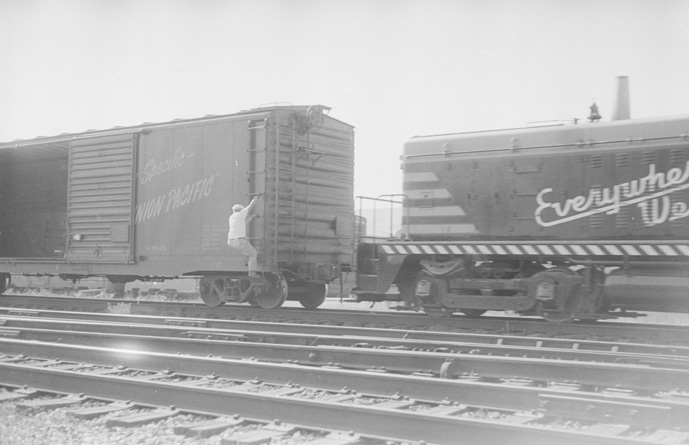
The cut's been made. Both couplers have been cut open. The brakey on the engineer's side signals "Get out of here" (highball). Engineer opens the throttle, runs for the switch. Conductor is at the switch.
Now the two brakemen scamper up the ladders and start tying down the handbrakes. Usually they didn't need to tie down more than one handbrake, but you can see this is several cars, and handbrakes don't always respond well enough to bring all of these cars to a stop in the time/space allowed. The engine is just now entering the facing point switch, and the conductor will throw it after the engine clears.
The cut of cars rolls by. Brakemen are still tying handbrakes down as tight as they can get them.
Just before this photo, the rolling cars connected with the stationary cars. First, from where I'm standing, you see the cars jump up in the air a bit. Then you see a lost of dust rise up. A moment later, you hear a loud CRASH. Then the switcher comes out.
Now we're leaving town. The Dispatcher's happy.Now a pop quiz. Who can describe a Dutch Drop (no, I don't mean being unkind to European people)
Remove | Alert Edit | Reply | Reply With Quote | Top
Lock | Archive | Remove
Lobby | Topics | Previous Topic | Next Topic
Restored from the Train-Sim.Com archive, captured March 9, 2002. About this archive.