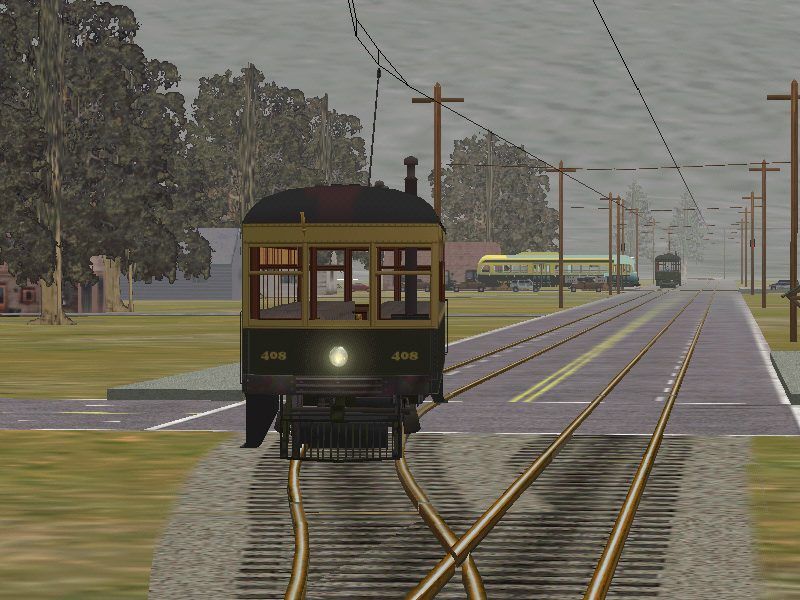
Good evening traction friends,Finally: Trolley and Interurban cars arrive and roll into town. Fresh from the paint shed! 
 I shot a sneaky-peeky-screeny or two while instruction and training of Wattmen began, assembling almost all types of cars in the two carbarns / carsheds of the route.
 After so many countless hours on the route, I needed a little break and decided it was about time the interurban and trolley routes of the Valley Transit Lines received their eagerly awaited (pre-owned ) rolling stock. So it was time to take out the olde spraycan and play around a bit.
 A few general remarks: As far as the route is concerned, I am still working hard at the final details. The to-do list is finally down to one page A4 (roughly letter format for those more familiar with North American standard norms). Basically the MtE is now complete - mmh, I like that sound, c-o-m-p-l-e-t-e, and some feedback from beta users is already flowing. I've started scripting the first activities, with 9 done so far, 5 of which tested and ironed out, four still needing more tuning to assure proper functioning. Another 5-8 are in the stage of a vague idea. While repeatedly running up and down the slopes while testing, I keep detecting things that need attention. Such as where to improve the signalling and the signal scripts, where to link a switchlamp I forgot, where to adjust the terrain under a floating road, where to move a building, change the timing of a grade crossing, correct a typo in a platform name, etc. etc.The most severe problem that remains is - short excurse into route builders Latin - that I still have to improve framerates on two or three of the densly populated tiles. I've detailed out the most frame-rate hungry buildings so that running the sim with your detail sliders lowered to 9 or 8 should still give you 95% of the scenery, just without the two or three structures that have a high poly count. In most places this helps to boost the framerate on low end machines without loosing a lot of detail. But the urban tiles have another problem, namely that they use a deadly combination: first a lot of vdbid's (viewing "spheres" if you want), combined with a high number of manually instead of automatically placed poles/gantries which the RE considers static scenery objects, assigning them to a specific vdbid instead of the general default vdbid - and that seems to mean a lot of unnecessary computing. So looks like I have to dig into those .w files to do some manual editing...
 But now for the trolley stock, as promised. As you remember, the main purpose of the MountE mainline is to give the NEC wire juicers some more room to roam. Now there are not too many trolleys/interurbans around that match that wire height. 6.2 is the standard (Mesaba Electric), and some stock even goes under the 5.4 wires of the Tokyo Hakone route. While I am confident that some more models will soon be made available with different shapes for diffeernt wire heights, I decided on using and - carefully - adapting some 6.2 metre stock for the interurban. To match them to the wires while hoping/waiting for shapes with 7 metre poles I decided to try scaling some of the cars - call it artistic freedom as we are talking a ficticious route here - and at least as far as my opinion is concerned, at least in one case the results were better than I had expected. In any acse, my primary goal is that the dimensions of all the Valley Transit stock matches among itself, with the Jewetts serving as my reference. Where models would be released in a scaled version, I plan to always include the orignal (unscaled) version of the shape file, with matching .sd and .eng file, so that users could always revert to the original shapeor use the car under 6.2 metre wires, too.Now: Meet the ValleyT Cars
--------------------------The Valley Transit Lines is my ficticious little entreprise running the urban and interurban services on the Mountain Electric turf (remember: The MtE mainline is a different kind of animal, with its P-Motors and MP54's). To add some variety, I decided the system would use trolley poles in the urban area, while the interurban route is already using pantographs for a while. Such combined systems exist(ed) - think of San Francisco where F-Street PCC's use trolleys, while the modern stock uses Faively pans - they just need elaborate aerial switches over the points. With MSTS's ugly catenary, forget 'bout them aerial switches in the sim...
 Anyway, this dualism will give you quite a collection of cars to choose from... This is the roster:Series 200: Brill Semi's, ca. 1900
----------------------------------
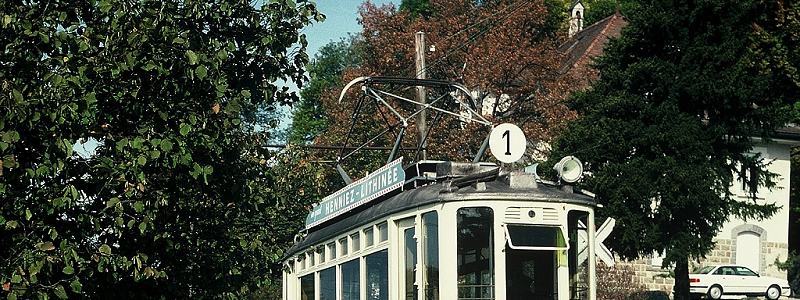
 Lets assume the backbone of the early Valley Transit Lines was the ubiquous Brill Semi's built in the early 1900s. Only a few of the original batch of 24 cars have survived into the days of MSTS, either in the form of the heritage car 204 in the original 1900s livery (two shades of green, golden trim lines), or in the form of back-up cars doing occasional supplemnts or substituting for more modern equipment needing repairs.

 The ValleyT calls this family of cars the Series 200, and you'll be able to enjoy them in three liveries: 1900's heritage, 1920's dark green with speedlines, 1950s green & cream. For those screenies, I used shapes scaled by 12% in height and length, but that leads to a more distorition on the car body that I actually like. I'll initially include the original, i.e. unscaled shapes for 6.2 metre wires, but maybe, if I can talk Tim Muir into doing a 7 metre version with just its pole rotated to reach the heigher wire...Series 300: Jewett Interurbans, ca. 1915
----------------------------------------
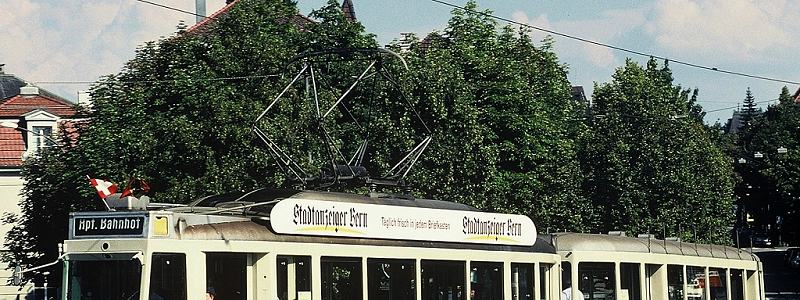
 The next batch of cars is based on Wayne Campbells L&PS Jewett interurban No.2. Actually, he generously ok'ed me using the shape file of his improved v2 (is this a sign of its upcoming release?) which does feature an interior, comes with a wattman inserted via the freightanimation line, and corrects a small bug with one of the rear windshield wipers travelling along about 2 metres to the left of the car... The Valley T has five Jewetts in passenger configuration that are the workhorses for the main section of the interurban. With Wayne's consent, I switched the pantographs in use by activating the rear pantograph instead of the front unit on some of the shapes, so that you have a little variety here, too. Alpha-ing out the interior, his car also makes for a terrific boxmotor. No wonder the ValleyT bought three of them, two early ones with wooden bodies, and a later addition with steel body. You may notice that the wooden body boxmotors only have one pantograph. Well, this little modification is also ok'ed by Wayne who informed me that one of the L&PS boxmotors actually also lost one of its pantographs in an accident and ended its career resembling my ficticous ValleyT 361 quite a bit (Btw: the shape file still calls for both pantographs, the permanently lowered unit is simply hidden inside the car ).


 So the ValleyT Series 300 comes in many variants: Passenger motors in dark green with speedline, front & rear pan, passenger motors in green&cream, front and rear pan, boxmotor wooden body, green with speedline and green&cream, one pan, boxmotor with steel body, only in green&cream, two pans... Series 400: Niles trolley and light interurbans, ca. 1924 (pre-owned)
---------------------------------------------------------------------
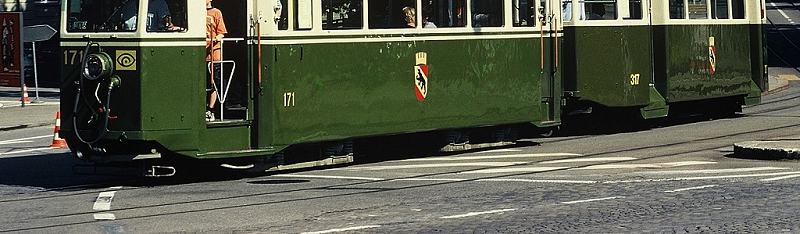
 Back to Tim's models. His ficticious Williamtte Valley 2100 inspired me to add 6 units of this light interurban motors - modified with pantographs from trolley pole operated urban trolleys - to the roster. The ValleyT uses them running light (solo) on the two short branches of the interurban, and in MU on the main section of the inetrurban when one of the Jewetts is unserviceable. The model is scaled ca. 12% both in length and height, but personally I have the feeling that this didn't hurt the fine car too much. Actually, when compared to the Jewetts before, the 400s looked a bit "low to the ground", and a 7 metre pan would probably look disproportionately high when added to the original model (Tim once mentioned testing such a variant, I'd personally prefer the slightly higher car body, but that is a matter of taste, I assume).Tim's and the PCCC's trolley equipped Mesaba Electric No.10 - basically the same model - inspired me to create a slightly scaled version of the Series 400 with trolley poles, to, assigning them to the urban part of the network.


 So the ValleyT now owns 12 individually numbered Niles cars now, 6 with trolley poles, 6 with pans, both version available in both 1920s green with speedlines and 1940s green&cream. (mental note: adjust that "moustache" on the front of some of the cars to better align with the headlights).Series 500: Not yet delivered
-----------------------------(Guess for which type the numbers are reserved for)Series 600: The PCC's circa 1940s
---------------------------------

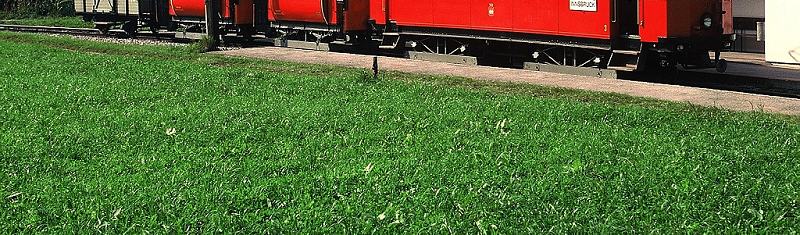
I have decided to finish off the round of purchasing some rolling stock for my little venture here with some state of the art PCC's, shiny new from the factory (well, back then). OK, Matt Harters' model unfortunately goes under 5.4 metre wires. And although the prototypical PCC's were definitely lower than older traction stock from the early 1900s, the unscaled models look really small when compared to the Jewetts - also in terms of width... So I again committed the crime of running the PCC's through Shape File Manager. I'd say boosting the original shape by 8-10% in all three dimensions should make them match the other ValleyT stock right on, without having their wheels leave the gauge of the rails, or their shapes benig distorted at all. Unfortunately, that still has the cars barely reach the 6.2 metre wires. That is about the maximum I would like to go with messing with the shape, as adding the additional height and length needed to reach the 7 metre wires makes the PCC's look wrong, namely too tall. Sorry, the screenies here are of such a distorted version, I do not intend to release them that much distorted as they are now, but will try hard to offer you a better solution before the cars will be released. E-mails will go out soon 


 I have prepared skins for four models though: The first PCC ordered by the ValleyT was an early model with standee windows, and thus has been the final car delivered in the dark green scheme with speedline. Due to financial constraints, the management could only order one follow-up car, which received a unique adaption of the then newly introduced green&cream scheme. Finally, the system managed to gobble-up two former Kansas City cars with large windows. They are the only cars to wear the latest colors that include a light green trim... Btw: All four repaints are based on skins Frederick Dreany originally created for his fine Toronto Transit PCC repaints.Uff! That much for the moment. Now it is time to get back to ironing out the route, and continue with the activities.
*** reaches for to-do list ***Kind regards!Lukas a.k.a Swissie
Printer-friendly page | Edit | Reply | Reply With Quote | Top
RE: MountE: New Cars on the Block (56k Warning), tryagin, Feb-04-04, 03:05 PM, (1) RE: MountE: New Cars on the Block (56k Warning), pacmancreator, Feb-04-04, 03:25 PM, (2) RE: MountE: New Cars on the Block (56k Warning), dvdhoven, Feb-05-04, 12:06 PM, (3) RE: MountE: New Cars on the Block (56k Warning), wacampbell, Feb-05-04, 12:18 PM, (4) RE: MountE: New Cars on the Block (56k Warning), ivanfurlanis, Feb-05-04, 04:13 PM, (5) RE: MountE: New Cars on the Block (56k Warning), Swissie, Feb-05-04, 05:30 PM, (6) RE: MountE: New Cars on the Block (56k Warning), wacampbell, Feb-05-04, 06:01 PM, (7) RE: MountE: New Cars on the Block (56k Warning), Swissie, Feb-06-04, 08:39 AM, (8) RE: MountE: New Cars on the Block (56k Warning), dvdhoven, Feb-06-04, 12:14 PM, (9) RE: MountE: New Cars on the Block (56k Warning), Swissie, Feb-07-04, 03:57 AM, (10) RE: MountE: New Cars on the Block (56k Warning), dvdhoven, Feb-08-04, 02:02 AM, (11)
Conferences | Topics | Previous Topic | Next Topic