Notice to all visitors and members of the Train-Sim.Com message forums: If you plan on using a signature banner in your posts, we would like to remind you that there is a maximum size for banners. That maximum is 450 pixels wide by 120 pixels high, and not to exceed 25k. Your compliance is appreciated. FORUM RULES Problems? There are two common reasons for problems with logging in and posting messages. The first is that you are running a firewall that prevents your messages from being sent to the server. The other is that you have cookies disabled; the DCForum software requires cookies to work properly.
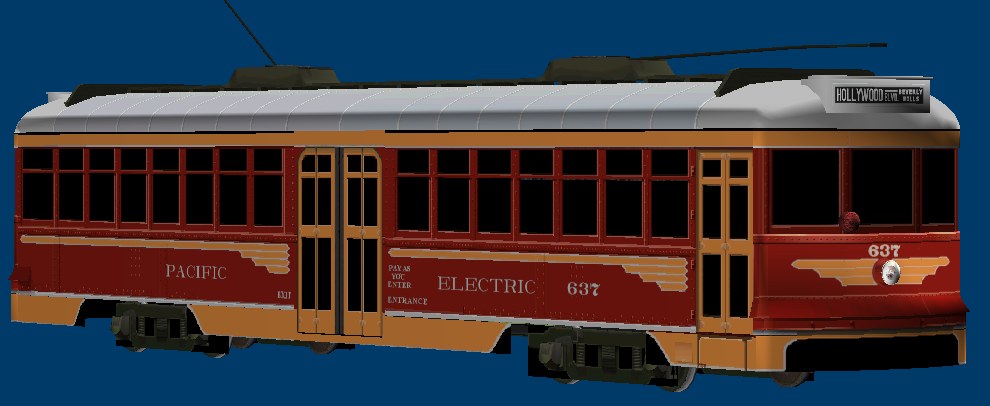
Hi gang,I am looking for good links for info on the Pacific Electric 600-700 Class passenger cars, specifically, their interior arrangements, contols, cabinets, seating (less gum), upholstery, headliners, flooring, and also details on their couplers. I have plenty of good exterior images, thanks to a few of you already helping. But I need a clear view, or drawings showing the side destination signs, and the route signs hung outside on the belt-rail on the front of the car, specifically the Hollywood Blvd. - Beverly Hills sign, and what colors they were. I have visited the Orange Empire Ry Museum pages, and all of their links. So, I'm hoping that I haven't exhausted all the avenues available, and that some of you traction nuts might know of some others, or that someone with PE knowledge can tell me what I need to know. I have started work on a "Hollywood", and need this info to continue on. Thanks for your time.Timtimmuir@wcn.net
Electric Railroad 3D Models Sumpter Valley B&B Gang Willamette Valley Route (No timetable for release)
There was a wealth of stuff published in the '60s, shortly after the demise of the Long Beach line. If you're near a trolley museum, you might get some specific advice there, though few of them have active libraries, that I'm aware of.You might want to e-mail OERM and ask them what's available, or barring that, what authors and titles you could search for on inter-library loan. I've had good luck with the latter. Send them the screen shot you posted here, because you've done an impressive job so far.... -Phil
There is some information on these and an old roll sign (red box, white lettering on black canvas IIRC) at the Niles Depot Historical Museum. I'll see if I can borrow a few of these books next time I go out there.I can scan the pictures, no problem, and get the dimensions of the destination box if you like too, but I don't think it will fit on my flatbed (though I can also photo it with my digi/still cam).Will let you know... Tim Frost NVTA Subway routes for BVE: The Union Atlantic Railroad: Your stuff's important!
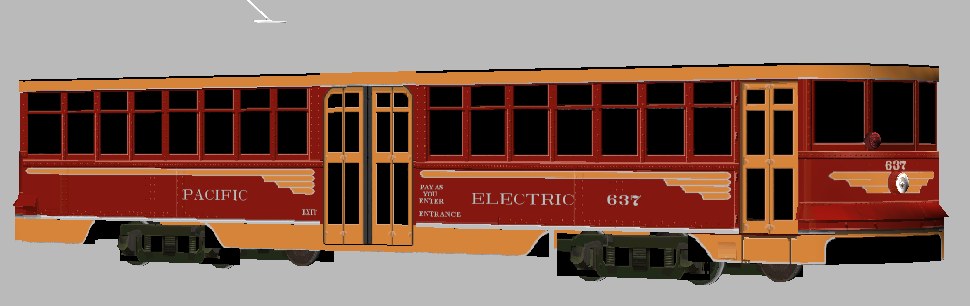
Tim, that would be great, of course, and much appreciated! Thanks for the footwork! Here's the latest view, just about to generate the 637 into the sim for the first time: basic shapes are done, now for the exterior details, then I can focus on the interior.Thanks, Tim. PS - I may do the "Valley Sevens" and will the Portland Traction versions. These are such cool motors!Timtimmuir@wcn.net
Electric Railroad 3D Models Sumpter Valley B&B Gang Willamette Valley Route (No timetable for release)
Hi Tim,thanks for keeping us informed on the process. And I'm impressed, to use mild terms! About the other versions: Yes, that would be beautiful! As far as I could dig out from a book on the PE (definitely no interior shots there, I flipped through all the pages) is that the cars were initially delivered from 1922 - 1928, numbered 600 - 759 and mostly used mostly in the Hollywood area in their early years.In 1938, cars 735 - 749 were modified for exlusive service from the central Subway Terminal to Van Nuys, which is what became known as the "Valley Sevens". The cars got more power & speed and the distinctive paintjob in red & cream.In a rebuilt / modernization program from 1939 - 1940, it seems the reminder of the fleet was more or less brought up to the same technical standard as the Valley Sevens, but the book is not giving more details unfortunantely. Following those modifications, the cars were deployed system wide, both on city lines, and suburban runs / interurban runs. In 1949-1951, the PE modernized the Hollywoods once more, making them suitable for one-man operations. The cars were also renumbered in that period (reportedly not in the original order, but just as they left the shops) and reassigned No.'s 5050 - 5181.The Hollywoods were MU equipped and often ran in trains of 2 or 3. The couplers had the necessary connections (Tim you asked about their appearance: Judging from some of the clearer photos, they look like an early version of "Scharfenberg" couplers, i.e. rectangular boxes with an elevated "head" on their left and a matching "dip" on their right side - when looking towards the car - & normally left unpainted in "rusty brown").Another detail: Judging from all the pictures in that book PE had a very strict policy of requiring that couplers at either end of a train must not remain in the center position - I guess to minimize the risk of additional injury in accidents - but be swung (and locked maybe?) to the far left position (again when looking towards the car).From the pictures, a few interior details can be descerned. It seems that in later years, the interior walls look to be painted in a light tone of green or blue (hard to say on those old shots, let's settle for some variation of turqouise). Seats facing forward in a darker color (brown or dark red), arranged 2+2, with a row per window. Wattman sitting in the center, rear platform often too crowded with standees to see where the conductor is during 2 man ops. Route details given on about half of the pictures either on a pale looking board with dark grey lettering or on a dark greyish board (like a blackboard) in white lettering. Text 3 to 5 lines, examples:1) from Venice Short Line: White sign, black letteringCULVER CITY OCEAN PARK SANTA MONICA VENICE BLVD. LOCAL SAN VICENTE BLVD. CONNECTIONall caps., the word local is underlined, text is centered.2) From Hollywood Line: Black sign, white letteringSUNSET BLVD. HOLLYWOOD BLVD. GARDNER ST.All caps, Gardner street all letters ca 4/3 larger than the other two lines, Sunset Blvd. in the first line indented, Blvd. in Hollywood Blvd. and St. in Gardner St. underlined each. 3) From various pictures/routes: Black sign, white letteringSUBWAY TERMINALwith the word Terminal written like in an "ascending sinus wave" instead of on a straight line. One picture shows the same lettering on a red sign (letters also in white).One car of the Hollywood line displays a blue board with white "HILL STREET" lettering. A few cars display yellow signs with the word "LIMITED" written diagonally, with the L being about 4/3 in size of the other characters. That's what I could dig out over the weekend. Lukas a.k.a Swissie